
For people in mental health care
When how you’re feeling gets in the way of closeness
Sex and intimacy are part of mental health too. Sex therapy can work alongside the care you already have.
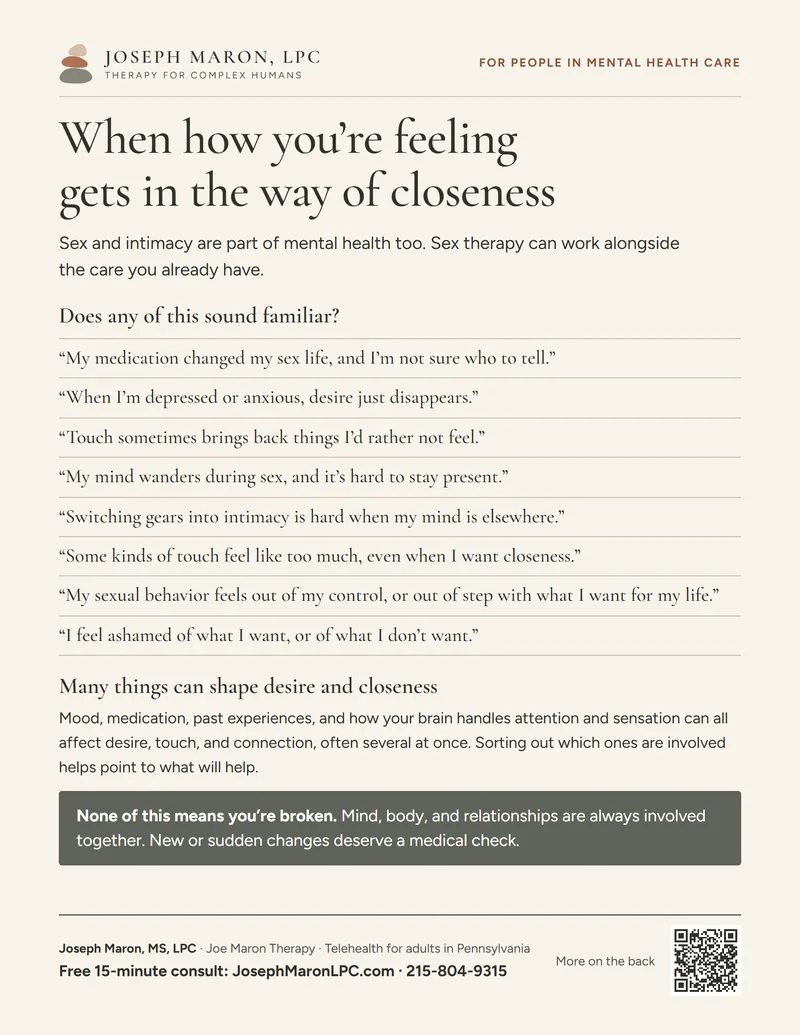
This is the printed handout, word for word. Print or download it at the end of the page.
Does any of this sound familiar?
- “My medication changed my sex life, and I’m not sure who to tell.”
- “When I’m depressed or anxious, desire just disappears.”
- “Touch sometimes brings back things I’d rather not feel.”
- “My mind wanders during sex, and it’s hard to stay present.”
- “Switching gears into intimacy is hard when my mind is elsewhere.”
- “Some kinds of touch feel like too much, even when I want closeness.”
- “My sexual behavior feels out of my control, or out of step with what I want for my life.”
- “I feel ashamed of what I want, or of what I don’t want.”
Many things can shape desire and closeness
Mood, medication, past experiences, and how your brain handles attention and sensation can all affect desire, touch, and connection, often several at once. Sorting out which ones are involved helps point to what will help.
How sex therapy can help, alongside your mental health care
Understand
Sort out what’s going on
Mood, medication, past experiences, and relationships each shape desire differently. Knowing which are involved points to what helps.
Safety
Go at a pace that feels safe
If past experiences show up in sex or touch, work at your own pace. Nothing happens that you haven’t agreed to.
Fit
Make intimacy fit you
Attention, energy, transitions, and sensory needs may shape intimacy. Build around them instead of fighting them.
Connection
Talk it through
Find words for needs, limits, and desires. A partner can join some sessions if you’d like, or you can do this work on your own.
What sex therapy is
Sex therapy is talk therapy about sexuality, intimacy, and relationships. There is no touch, no exam, and nothing physical happens in sessions.
Your mental health care still matters
Sex therapy doesn’t replace your therapy or psychiatric care. With your permission, I coordinate with your therapist or prescriber. If you think a medication is affecting your sex life, talk with your prescriber before making changes.
Getting started
Request a free 15-minute consult at JosephMaronLPC.com or call 215-804-9315.
Telehealth for adults in Pennsylvania. Private pay; superbills provided for out-of-network reimbursement.
I’m Joseph Maron, MS, LPC. I work with adults on sexuality, relationships, identity, and ADHD.
Joe Maron Therapy · PA License PC017785 · Doctoral student in human sexuality, Widener University · Certificate in Affirmative Therapy for Transgender Communities · ADHD-CCSP · LGBTQ+ affirming care
Print this handout
-
Patient handout · two sides
When how you’re feeling gets in the way of closeness
For your clinician: the matching provider sheet.